
Between May and September 2025, a group of volunteers from the Reimagine Peace community held that collective space during a moment of transition and uncertainty. This is a reflection on what we attempted and what we learned about collective leadership during this phase.

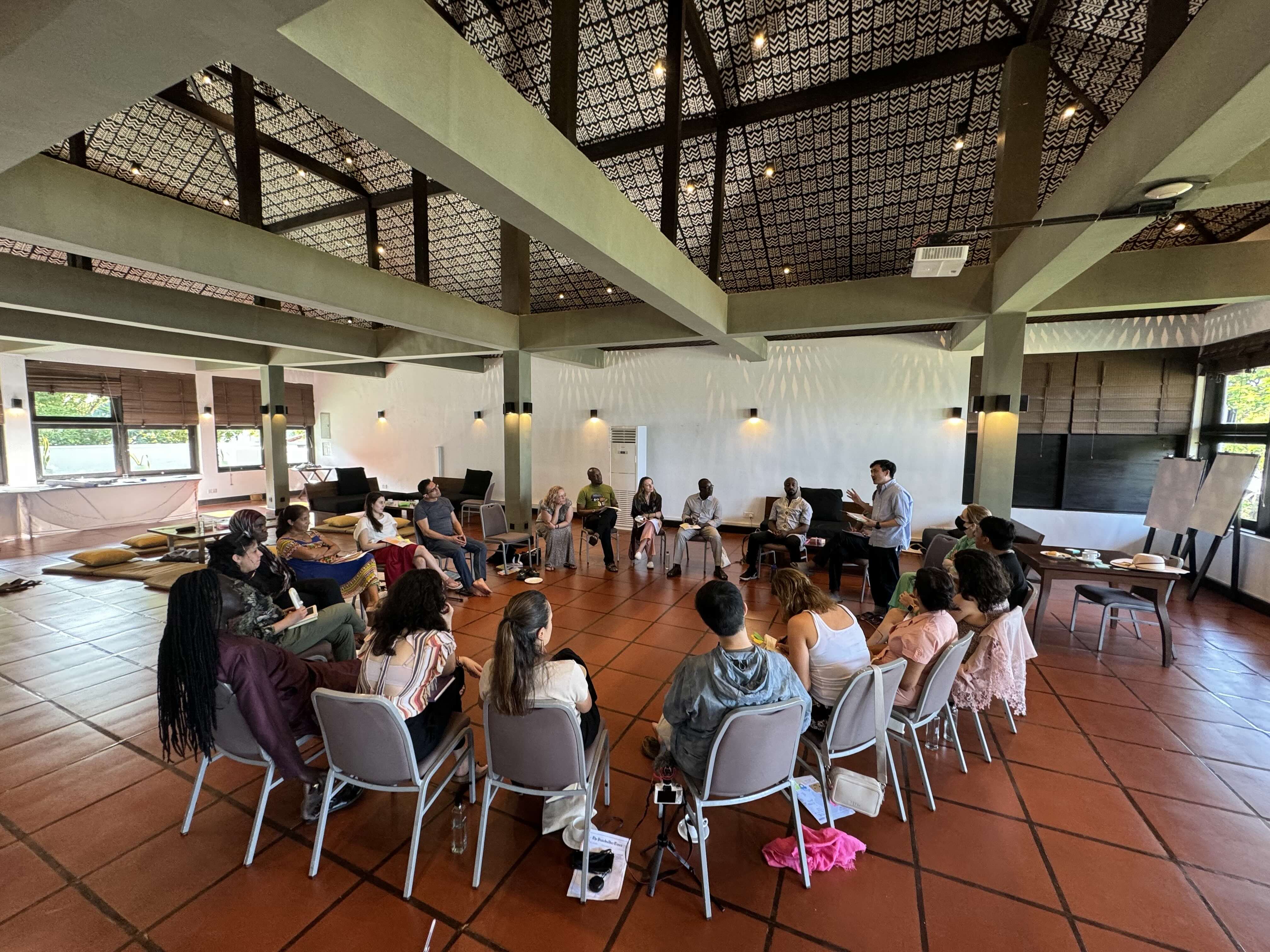


We are kind of disoriented right now, and I think there’s value in naming where we are. When you are disoriented, whether you’re trekking or you’re in the middle of a journey, I think there are two things that you know you have to do. The first one is to look at your compass or your North star. And then, to look around (...) my proposal is… let’s take time to reorient ourselves in two ways, you know, reviewing what is our reading of the peacebuilding field, and what are our aspirations, what are the ideas? Whereis our energy? I think that would also allow our ideas to have some sort of atent.
Marc Batac, Reimagine Community Meeting, May21st
What do you do in moments of uncertainty or leaps into the unknown? In April 2025, Reimagine Peace arrived at such a moment. We stood at the edge of an abyss, not knowing what paths might open, whether there were bridges to cross it, or whether its depth was minimal and we could simply descend and walk through it. We were in absolute unknowing — in that void that can make space both for the infinite possibilities of reimagining and for the fears we carried. The fixed and growth mindsets we had been conditioned into by the traditional project-based system were far from preparing us for moments like this.
Until then, and since 2022, Reimagine had run collective leadership initiatives supported by a Hosting Team, or groups of community members who formally led the way. These groups received honoraria for their service, and the last one was the “Transition Group,” appointed by the community in late 2024. However, their governance proposals for defining the next phase were not endorsed by community members. In fact, I was one of the people who did not feel safe enough to try them. It was a difficult moment for everyone.We had imagined this transition very differently, and we also understood that not endorsing the proposals carried the risk of a void, uncertainty, and the myriad possibilities—both negative and positive—that lay ahead.
Together with Laura Vargas from Colombia and Raul Maza from Mexico, we felt called to voluntarily hold that moment and do something to meet it with presence, care, and reflection. Soon, Marc Batac from the Philippines and Aung Thant from Myanmar joined this impulse, and together we put forward a proposal to the community to facilitate seven virtual sessions from July to September.
We called ourselves the “Drumbeaters”because we decided to play and paddle together in this ship without an apparent direction. As we said in our initial presentation: “We do not have the“captain” fully clarified/identified yet, but the captain is not the only form of leadership in a ship.”
We co-designed a facilitation process based on the following hypothesis:
“IF we have clearer and shared sense of our“big tent” grounded on more concrete understanding of each other’s peacebuilding work, motivations, challenges, and contexts; and
IF we have a clearer sense of existing capacities and commitments of the members of the community,
THEN… we will be able to engage in meaningful collective action as a community”
We therefore proposed a three-step process with questions designed to help us explore this hypothesis:
· “Name the common challenges: What challenges are we facing as peacebuilders, and how is it linked to the system? What is wrong and harmful with the peace building system/status quo? Why do we need to reimagine it?
· Name where we are in thesystem: Are we the “best” or “right” people to do this? Where are we in this system? What is our position in this system? And what can we change/influence given our different position vis-a-vis the system?
· Name what is emerging: What ideas are my energy drawn towards? What questions and curiosities were being inspired?”
It is important to note that ReimaginePeace has around 23 community members, and that until that point we did not know in detail the work each person had been developing in their countries or regions around social justice, human rights, and peace. When Adriana Santamaria and Elise Ford decided to found Reimagine Peace as a space to accompany local peacebuilders and activists from different parts of the world in reimagining the system through collective action and emergent strategy, they brought together people from four continents who shared this aspiration. Most of them had not known each other beforehand. And although we had been meeting as a community since 2022 (some even since 2020), we did not truly know the depth and scope of what each person was doing locally. Hence the importance of making our translocal impact visible in order to arrive at a more organic collective vision.
We also distributed facilitation responsibilities among other community members, session by session, as several of us who had started the “Drumbeaters Group” were not available to facilitate all seven sessions from July to September. I, in fact, became a mother through adoption in August. So different people stepped forward according to their energy and availability: Vesna Bajsanski-Agic from Bosnia-Herzegovina, Alba Purroy from Venezuela, and Ching-Yin Yeung from Hong Kong.
It was the first time we had attempted a fully voluntary process in the community, without any stipends, and that, de facto, created a different dynamic and a different way of being in the space.Betting on volunteerism was, in itself, an experiment: an invitation to ask ourselves what emerges when presence is not conditioned by a contract but sustained solely by the desire to be there. Paradoxically, this built a stronger sense of community and, at the same time, exposed the limitations and asymmetries that a structure without compensation inevitably reproduces in a translocal context.
By August, fifteen community members had completed the form we designed so the rest of us could learn about the most significant peacebuilding initiative they had been part of, as well as the system-related challenges they had faced. Of course, they also presented this content during the community calls we facilitated. Hearing and reading them was moving and powerful, given the resonances and mutual admiration we began to feel.
Across different countries, sectors, and approaches, certain patterns began to emerge: the exhaustion of project-based funding that rewards speed over depth; peacebuilding seen as an intervention from the outside and by experts; growing polarization accompanied by distrust, fragmentation, and stigmatization; and the burnout and hopelessness that arise from trying to build peace within retraumatizing systems.
We used artificial intelligence (AI) tools to synthesize these reflections and brought them back to the community in a participatory prioritization exercise. Three challenges were selected based onhow “remote or closer” people felt in relation to each of them: first, polarization; second, projectization and competition between organizations; andthird, peacebuilding as an externally driven and expert-led practice. It was very valuable to arrive at these collectively, through our own stories and lived experiences, and it was striking to see how, through this participatory process, polarization began to occupy an important place as a translocal challenge that had not previously featured prominently in our conversations.
By September, a richer map of ideas hadbegun to take shape around the third step: “What ideas is my energy drawn toward? What questions and curiosities fill me with inspiration?” Some of those that emerged included dialogue, deep listening, and humanizing narratives toaddress polarization; questions around the role of AI in this context; initiatives to bring an experimental spirit — rather than a project logic —into peacebuilding; and a recurring thread about mental health and the need fora retreat or a kind of sanctuary for peacebuilders and activists. When it wasall over, I felt we had ended with a living landscape of energy and possibility that, until now, we have not yet returned to.
Looking back, it is worth naming honestly some patterns: the most alive conversations were always the most personal and human ones, those that started from our own stories rather than from frameworks or governance questions. Participation and the workload were not evenly distributed, and that asymmetry — shaped also by differences in availability and socioeconomic contexts — is something we still have to digest and speak about openly.
The cycle ended without a formal agreement on priorities and without a clear transition regarding what would come after our mandate as “Drumbeaters.” Fortunately, Lina Ibañez from Colombia proposed facilitating a series of conversations that continued this process and went deeper into some of the themes and concerns that had emerged.
The following learnings were gathered from the patterns I identified throughout this cycle. They are practical starting points, not prescriptions, to be considered when designing future processes and activities.
· The importance of the relational dimension of our community: It is always worth dedicating energy and attention to strengthening the web of relationships that holds us together, while in parallel focusing on things like strategy or governance design. Relationships are not the backdrop to the work — they are part of the work itself.
· Building a shared language: Before ideating or deciding, it is essential to take time to explore and make collective sense of the key concepts we are discussing. What do we mean by experiment? What do we mean by collective leadership? What do we imagine when we talk about a “common tent”? Without this step, we risk agreeing on the words but not on the ideas.
· Designing for the sustainability of voluntary processes: This phase showed us that as a collective we can carry out certain processes on a voluntary basis. It is worth opening conversations about what can remain voluntary, what deserves compensation, and how socioeconomic differences shape who can give what —conversations that, if left unnamed, do not disappear but simply become invisible.
· Treating the interconnection of challenges as a design principle: After seeing the themes that emerged and the interconnections between them, between our work and our approaches, it is likely that our community will give rise to experiments that address multiple dimensions at once — connecting, for example, polarization, trauma, and artivism. Far from being a complication, that is precisely what has the greatest potential to reimagine and change the system.
· Making the community’s power visible to itself: I was struck by the gap that surfaced in one of the exercises: the agency we perceive ourselves to have is minimal, despite the real reach of our work across different latitudes. Regular rituals — a brief update at the start of each call, a living map on Miro — can help close that distance.Collective visibility is key to building collective vision, and the idea of creating “islands of coherence” — Prigogine, Theory U — to catalyse systemic change from communities like ours is gaining increasing traction.
· Distinguishing ‘not deciding yet’ from ‘not deciding’: The community sometimes needs more time and information before making decisions, and honoring that need is legitimate and respectful — especially on matters of operations and resource management. However, indefinite deferral can become a pattern that prevents forward movement. In future cycles, it is worth distinguishing between “let’s not decide yet” — with a clear timeline and conditions for revisiting — and “we cannot decide” as an indefinite state.
· Designing the handover explicitly: Every cycle or experiment should include concrete actions for closure and transition. The ending should not only harvest learnings and take stock of the journey — it should also actively bridge to what comes next, with clear agreements about who holds what in the following stretch.
———
The full analysis — including the narrative timeline of the facilitation process, learnings and tensions from each step, cross-cutting themes, and the detailed reasoning behind each learning — is available in the Drumbeaters Facilitation Journey document.


%2011.35.24%E2%80%AFa.m..png)
%2011.14.39%E2%80%AFa.m..png)
%2010.12.53%E2%80%AFa.m..png)